Kaif
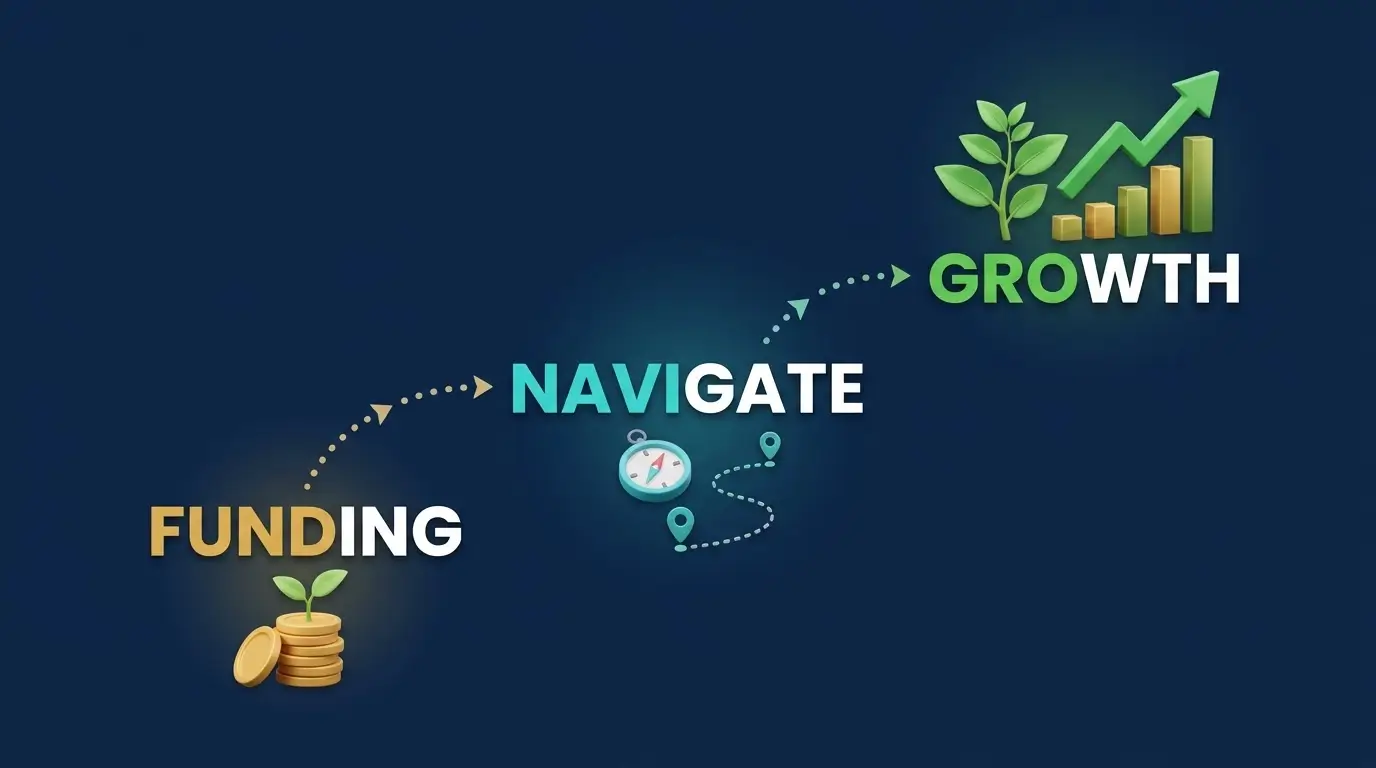
If you searched for “growth navigate funding,” you’ve likely met two different things under one name. One is a loose idea about getting a business ready to raise money. The other is Growth Navigate, an advisory website that markets funding help. This guide explains both, shows how to plan a raise around a real milestone, and gives you a checklist for vetting anyone who offers to find you capital.
Key takeaways: Growth navigate funding is an informal term for capital readiness, not a formal financing product. Growth Navigate is also a separate advisory brand. Raise money for a specific milestone, match the funding type to the job, and verify any adviser’s fees and track record before signing.
What Is Growth Navigate Funding?

Growth navigate funding is a loosely used phrase for preparing a business to raise capital: clean financials, a clear milestone, and a funding source matched to your stage. It is not a formal finance product. Growth Navigate is also the name of a separate advisory website that markets funding and financial services.
Most pages using the phrase describe a readiness approach. One describes it as strengthening financial records and aligning funding sources with a realistic scaling plan. Another frames it as identifying, securing, and deploying capital in line with a company’s stage and targets, putting the right source and timing ahead of the largest check.
Concept vs. company vs. lookalikes
| Name | What it is |
|---|---|
| Growth navigate funding | An informal capital-readiness idea used in articles |
| Growth Navigate (growthnavigate.com) | An advisory website marketing funding, coaching, and financial services |
| Navigate | A Singapore-based mapping platform that raised $7.6 million, unrelated to the above |
| Navigate Ventures | A fund investing in B2B SaaS and internet companies between Series A and growth rounds, also unrelated |
If you see a funding total attached to “Navigate,” check which company it belongs to.
Why Preparation Matters More Than the Pitch
Raising money without a plan tends to backfire: you may take capital that doesn’t fit your timeline or spend it before your systems can measure results. The readiness idea answers that with three questions:
- Can you show accurate, current financial records?
- Is your revenue model clearly defined?
- Do you know what the money must achieve?
The last question is the one that changes decisions.
A Milestone-First Method for Choosing Capital
Here is a simple process you can apply to any raise.
Step 1: Define one milestone
“Grow faster” can’t be budgeted. “Reach $1.5 million in annual recurring revenue” or “fund inventory for peak season” can.
Step 2: Calculate the real cash gap
Estimate cash needed to reach the milestone: projected burn, one-time costs, and a reserve, minus cash you already have. Build it month by month rather than multiplying today’s burn by a number of months.
Step 3: Match capital to the job
| Funding route | Best for | Main trade-off |
|---|---|---|
| Customer revenue | Proving demand | Can be slow |
| SAFE or convertible note | Pre-seed and bridge funding | Future dilution; stacked SAFEs hide total ownership given up |
| Priced equity | High-risk, high-growth plans | Dilution plus investor rights |
| Bank or SBA-backed loan | Inventory, equipment, working capital | Repayments reduce cash |
| Grants (such as SBIR/STTR) | Qualified research and development | Eligibility and reporting rules |
The SBA says most 7(a) loans can reach $5 million, with eligible uses including working capital, equipment, and real estate. Debt should be judged on whether your cash flow can support repayment, not on avoiding dilution.
Step 4: Prepare for diligence
Investors and lenders typically want accurate books, a current cap table, a forecast, and proof behind revenue claims. Gather these before outreach, not during it.
Step 5: Tie spending to checkpoints
After funding, link each major expense to a measurable result, such as sales hires to pipeline and payback, or product spending to retention. If a result doesn’t move, redirect the spend.
A worked example (hypothetical)
A small online retailer wants to finance holiday inventory. Its milestone is stocking 3,000 units. It estimates a $120,000 cash gap after counting supplier payments and a reserve. Because inventory sells quickly and generates predictable cash, a short-term loan fits better than giving up equity. If sales lag, the downside plan cuts reorders. The point is the sequence: milestone first, gap second, instrument third.
What 2026 Funding Data Shows
Market averages help you benchmark, but headline totals can mislead.
Carta reported that U.S. startups on its platform raised $3.19 billion across more than 11,500 pre-seed SAFEs and convertible notes in Q2 2026, with the average instrument reaching $276,000, up 27% from a year earlier. That rise reflects larger amounts going to fewer companies, and few pre-seed deals exceed $2.5 million. The share of pre-seed dollars going to AI startups is holding near 50%.
Carta’s newest release adds a similar picture: Q3 2026 was the largest quarter of the year for pre-seed cash invested, but the smallest by instrument count.
What this means for you: money is available, but it is concentrated. A founder in a non-AI sector shouldn’t assume the average reflects their odds or pricing. Compare against peers at your stage and in your industry.
The Growth Navigate Brand: What the Public Page Shows
Since the name is also a business, here is what its About page states, without judging whether it delivers.
The page presents five service areas: business funding and capital acquisition, business coaching and financial advisory, financial planning and risk management, investment strategy and wealth building, and digital transformation and fintech solutions. It says it connects businesses with investors, secures funding, and structures deals that close. It names two team members, Samantha Steele as Director of Financial Strategy and Sayush Khandelwal as Head of Finance and Tech.
Things to verify directly
A few details on that page are worth checking yourself:
- The listed phone number uses a 555 exchange, a prefix generally associated with fictional or placeholder numbers. Call it and see whether it connects.
- One team profile’s LinkedIn link points to the company page of the site builder Wix, not to a personal profile.
- The About page I reviewed doesn’t publish fees, named transactions, or independently verifiable client results. Another review likewise found no portfolio-level fundraising record on the pages it examined.
None of this proves a problem. It means you should do due diligence before paying, as with any adviser.
How to Vet Any Funding Adviser
Use these questions with Growth Navigate or anyone else.
- Who are you legally? Ask for the registered business name, location, and licenses relevant to your jurisdiction.
- Who does the outreach? Find out who actually contacts investors or lenders.
- How are you paid? Compare retainers, success fees, and equity requests. Get all fees in writing.
- Can I speak to past clients? Ask for references you can contact, and what they raised.
- Are there conflicts of interest? Ask whether the adviser is paid by lenders or investors.
- Is any of this regulated? Raising private capital falls under securities rules. SEC guidance notes that private offerings usually rely on an exemption from registration, so confirm whether any part of the work involves regulated activity and use qualified legal counsel for the actual deal.
- How is my data handled? You’ll share financials, so ask about security and confidentiality.
Red flags
- Guaranteed funding or fixed timelines
- Large upfront fees with no defined work
- Reluctance to name a legal entity or provide references
- Pressure to sign quickly
A 90-Day Capital-Readiness Plan
| Window | Focus | Output |
|---|---|---|
| Days 1-30 | Clean books, update the cap table, define your milestone and cash model | One reliable set of numbers |
| Days 31-60 | Stress-test the forecast, build a data room, research suitable funders | A defensible ask and a target list |
| Days 61-90 | Refine the pitch, rehearse diligence questions, begin warm outreach | A controlled process |
Include a base case, a downside case, and a no-raise case. The downside case shows investors you understand what happens if revenue lands late.
Pros and Cons of the Readiness Approach
Strengths
- Forces clarity on why you need the money
- Reduces the risk of mismatched or over-priced capital
- Makes diligence faster
- Works whether you raise or not
Limitations
- It is a mindset, not a source of money
- Preparation doesn’t guarantee investor interest
- Some startups need to raise early because speed or research costs demand it
- The term has no formal definition, so articles use it inconsistently
Frequently Asked Questions
What is growth navigate funding?
An informal term for preparing a business to raise capital and matching funding to its stage and milestones. It isn’t a formal financing product.
Is Growth Navigate a funding provider?
Its website presents it as an advisory brand that markets funding, coaching, and financial services. It doesn’t present itself as a lender in the page reviewed.
How do I know if an adviser can really get me funding?
Ask for contactable references, a written scope, a clear fee structure, and proof of outcomes. Be wary of guarantees.
Equity or debt: which is better?
Equity suits uncertain, high-growth plans because there’s no repayment schedule. Debt suits predictable cash flow that can cover payments.
How much should a startup raise?
Enough to reach its next milestone, plus a reserve. Calculate the cash gap, then stress-test it.
Are SAFEs debt?
No. A SAFE is a right to future equity, not a loan, but multiple SAFEs can add up to meaningful dilution.
Can I use an SBA loan instead of venture capital?
Sometimes. SBA-backed loans can fund eligible uses if you can repay them, but they aren’t a universal substitute for equity.
Conclusion
Growth navigate funding is best understood as a discipline: define the milestone, calculate the gap, pick the capital that fits, and measure what the money changes. The phrase isn’t a formal product, and Growth Navigate is a separate brand whose claims you should verify like any other. Prepared founders get better terms and fewer surprises.